
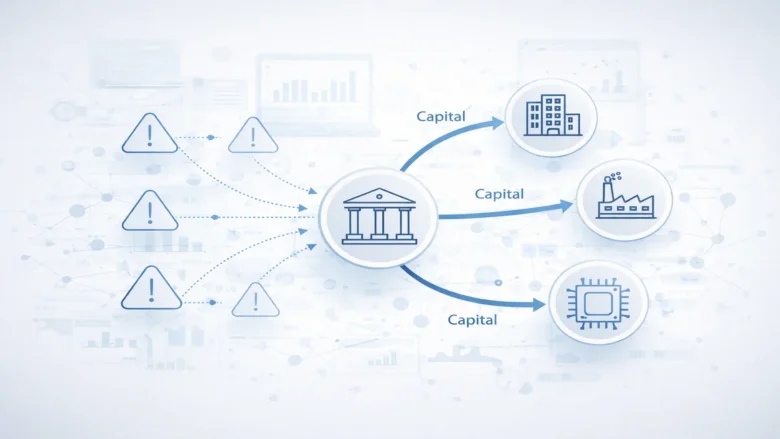
In today’s global financial system, capital moves through complex regulatory frameworks, interconnected funding sources, and trading platforms that shape how risk is managed and shared. Investment decisions are influenced not only by expected returns but also by rules for clearing trades, standards for reporting, margin requirements, and systems for monitoring financial institutions. Banks, institutional investors, asset managers, and other financial firms operate within these structures, which affect not just where money flows, but how risk is measured and controlled.
Modern markets are carefully organized. Elements such as rapid liquidity channels, capital requirements, and reporting practices influence investment choices. This structure determines how funding is allocated, how prices are formed, and how balance sheets are constructed. Risk does not disappear—it moves across parties, industries, and financial products, often following standardized procedures.
To understand today’s capital flows, it is essential to look at these broad systems rather than just individual transactions.
Market Structure and Capital Allocation Dynamics
Fast-Moving Trading Systems
Money is invested through trading systems that operate simultaneously across multiple platforms. Order-matching systems, clearinghouses, and settlement platforms determine how quickly capital can be accessed and how risks appear. The design of these systems affects price formation, transaction costs, and the attractiveness of different assets.
Standardized Contracts vs. Direct Agreements
Markets trading standardized contracts and those operating via bilateral agreements function differently. Standardized contracts allow central clearing and netting, reducing counterparty risk. Direct agreements spread risk through less visible channels. Central clearing requirements encourage more trading of standardized instruments, impacting how institutions manage collateral and allocate capital to meet margin obligations.
The Role of Market Makers
Market makers use their own funds to provide liquidity, absorbing order imbalances and redistributing risk. Regulatory rules on capital requirements affect their ability to take on positions. Higher capital charges may reduce liquidity, causing price fluctuations not solely due to market fundamentals, but due to constraints imposed by regulatory frameworks.
Technology and Algorithmic Trading
Technology has accelerated trading and interconnected various asset types. Automated systems route orders to achieve optimal pricing and execution speed. Capital allocation now responds to small incentives such as fee schedules, tick sizes, and latency advantages. Risk spreads not only through asset choice but also through order-routing logic and collateral management.
Clearinghouses and Central Counterparties
Central counterparties (CCPs) reduce counterparty risk by acting as intermediaries between buyers and sellers. Default funds and margin pools distribute potential losses among participants. Investment decisions take into account the cost and benefits of participating in these collective safeguards, linking capital allocation to shared risk buffers that support market stability.
Institutional Capital Frameworks and Investment Boundaries
Regulatory Capital Rules
Banks, insurance companies, pension funds, and asset managers operate under regulatory frameworks defining capital allocation. Banks adhere to rules on risk-weighted assets, leverage ratios, and liquidity coverage. Insurance companies adjust buffers based on underwriting and investment risk, while pension funds and asset managers follow diversification rules to balance returns with obligations.
Risk Weighting and Asset Classification
Capital requirements translate asset characteristics into regulatory costs. Government bonds, corporate bonds, structured products, and equities face different treatment. As capital requirements rise for certain instruments, institutions adjust portfolios to remain compliant while pursuing target returns.
Liquidity Rules and Asset Demand
High-quality liquid asset thresholds encourage holding instruments stable under stress, affecting demand for sovereign debt and short-term funding. Investment decisions link to regulatory definitions of liquidity, creating feedback loops between classification and market pricing.
Stress Testing and Forward-Looking Oversight
Supervisory stress tests require institutions to demonstrate resilience under hypothetical adverse scenarios. Capital planning includes projected losses and revenue changes under different economic conditions. Investment strategies are assessed against modeled downturns, influencing exposure to volatile sectors or complex instruments. Stress testing extends regulatory influence beyond static ratios, embedding forward-looking risk assessment in portfolio construction.
Institutional Mandates and Governance
Endowments, sovereign wealth funds, and public pension systems operate under governance structures balancing return goals and policy constraints. Investment committees evaluate risk distribution across asset classes relative to long-term obligations. Regulatory rules interact with these governance structures, creating investment dynamics that are neither purely discretionary nor purely regulatory.
Financial Intermediation and Risk Distribution Mechanisms
Banks and Securitization
Banks originate loans and may convert portions of their balance sheets into securities. Asset-backed securities, collateralized loan obligations, and structured credit vehicles transfer risk to investors with varying risk appetites. Each step in the chain modifies risk exposure.
Securitization transforms illiquid assets into tradable instruments. Credit risk moves from banks to capital markets, where it is divided into senior and junior tranches. Senior tranches absorb losses only after junior layers are depleted, enabling investment across the risk spectrum. Regulatory treatment of tranches affects pricing and demand.
Shadow Banking and Alternative Channels
Shadow banking entities—including money market funds and investment vehicles—provide credit outside traditional deposit-taking institutions. Their investment ability depends on collateral value and funding stability. While reforms have increased transparency and reduced risk, these intermediation chains remain complex.
Derivatives and Hedging
Interest rate swaps, credit default swaps, and currency forwards allow institutions to reallocate exposure without moving underlying assets. Hedging activity distributes risk according to each participant’s capacity to absorb volatility. Central clearing of standardized derivatives concentrates risk management, while bilateral contracts maintain decentralized exposures. Investment decisions factor in hedging costs and margin requirements.
Collateralized Funding and Liquidity
Repurchase agreements, securities lending, and other collateralized funding mechanisms support leverage and liquidity provision. Haircuts and margin calls transmit stress across participants. Investment is influenced not only by asset quality but also by the stability and valuation of collateral in funding channels.
Transparency and Reporting
Disclosure requirements clarify exposure concentrations and interconnectedness. Reporting frameworks for securitization and derivatives allow investors and regulators to track risk distribution. Institutions adapt their investment strategies to account for reporting obligations and supervisory scrutiny.
Cross-Border Capital Mobility and Regulatory Divergence
International Operations and Ring-Fencing
Capital flows across borders encounter different regulatory systems, tax rules, and reporting standards. Banks with subsidiaries must balance group-level goals with local capital buffers. Ring-fencing measures restrict capital and liquidity transfers in some jurisdictions, influencing funding structures and risk localization.
Currency Exposure and Hedging
Foreign exchange markets facilitate international investments but introduce volatility risk. Hedging strategies allocate capital to derivatives that mitigate currency fluctuations. Regulatory oversight of FX settlement and capital controls shapes investment pathways.
Global Regulatory Coordination
Bodies such as the Basel Committee provide common standards, yet implementation differs across countries. Calibration and supervisory interpretation affect competitive positioning and capital allocation. Regulatory diversity influences how risk is distributed globally.
Emerging Market Dynamics
Capital inflows in emerging markets can strengthen domestic liquidity but increase volatility during downturns. Macroprudential policies, such as countercyclical buffers, guide capital absorption and allocation. Cross-border investments respond not only to yield differences but also to signals regarding systemic risk.
Liquidity Architecture and Market-Based Constraints
Short-Term Funding Channels
Repurchase agreements, commercial paper, and interbank lending provide essential liquidity. Capital allocation is closely linked to access to these stable funding sources. Institutions with multiple liquidity sources enjoy greater flexibility in structuring portfolios.
Repurchase Agreements and Haircuts
Securities serve as collateral in repos, enabling leverage and market-making. Haircuts adjust to reflect perceived risk. In stress periods, higher haircuts reduce borrowing capacity and investment flexibility, potentially forcing asset sales that propagate risk.
Central Bank Facilities
Central banks provide liquidity through standing lending facilities and emergency programs. Access criteria impose constraints, shaping institutional behavior. Investment decisions often factor in expected central bank support.
Money Market Funds and Regulation
Post-crisis reforms altered liquidity requirements and redemption mechanisms for money market funds. These changes affect demand for commercial paper and short-term sovereign instruments, influencing capital flows.
Balance Sheet Constraints
Supplementary leverage ratios and liquidity coverage metrics limit certain activities. Institutions adjust asset holdings to comply with these regulations, aligning risk distribution with available stable funding.
Governance, Risk Oversight, and ESG Considerations
Corporate governance frameworks guide investment decisions and risk management. Board committees, risk management teams, and internal audit functions monitor exposure concentrations and regulatory compliance. Risk appetite statements define thresholds that shape capital deployment.
Environmental, social, and governance (ESG) factors increasingly influence portfolios. Disclosure mandates for climate and sustainability risks affect industry allocation. Technology-driven analytics, scenario modeling, and data aggregation tools enhance oversight but require governance to ensure accuracy. Shareholder expectations and fiduciary duties further influence investment boundaries.
Capital allocation today reflects regulatory, operational, and governance structures. Risk moves through markets according to clearing rules, funding conditions, liquidity availability, and supervisory oversight, shaping how institutions deploy capital in a complex system.
Conclusion
Modern financial systems operate within a layered framework of regulations, intermediation channels, market infrastructure, and liquidity mechanisms. Capital allocation and risk distribution are guided not only by returns but also by regulatory requirements, funding stability, and governance frameworks. Cross-border investments and technological integration add complexity, while stress testing, transparency, and ESG considerations shape long-term strategic decisions. Understanding these systems is essential for navigating today’s interconnected global markets.
FAQs
1. What determines where capital is invested in modern markets?
Investment is guided by expected returns, regulatory capital rules, liquidity requirements, and risk management structures.
2. How do central counterparties reduce risk?
CCPs act as intermediaries between buyers and sellers, mutualizing exposure through margin requirements and default funds.
3. Why is liquidity important for investment decisions?
Access to stable short-term funding allows institutions to maintain positions, leverage investments, and respond to market stress.
4. How do cross-border regulations affect capital allocation?
Differences in local rules, ring-fencing, and capital controls influence where capital can be deployed and how risk is distributed internationally.
5. What role does governance play in risk management?
Corporate governance frameworks establish risk limits, monitor exposure, and ensure compliance with regulations, influencing how capital is allocated and portfolios are managed.