
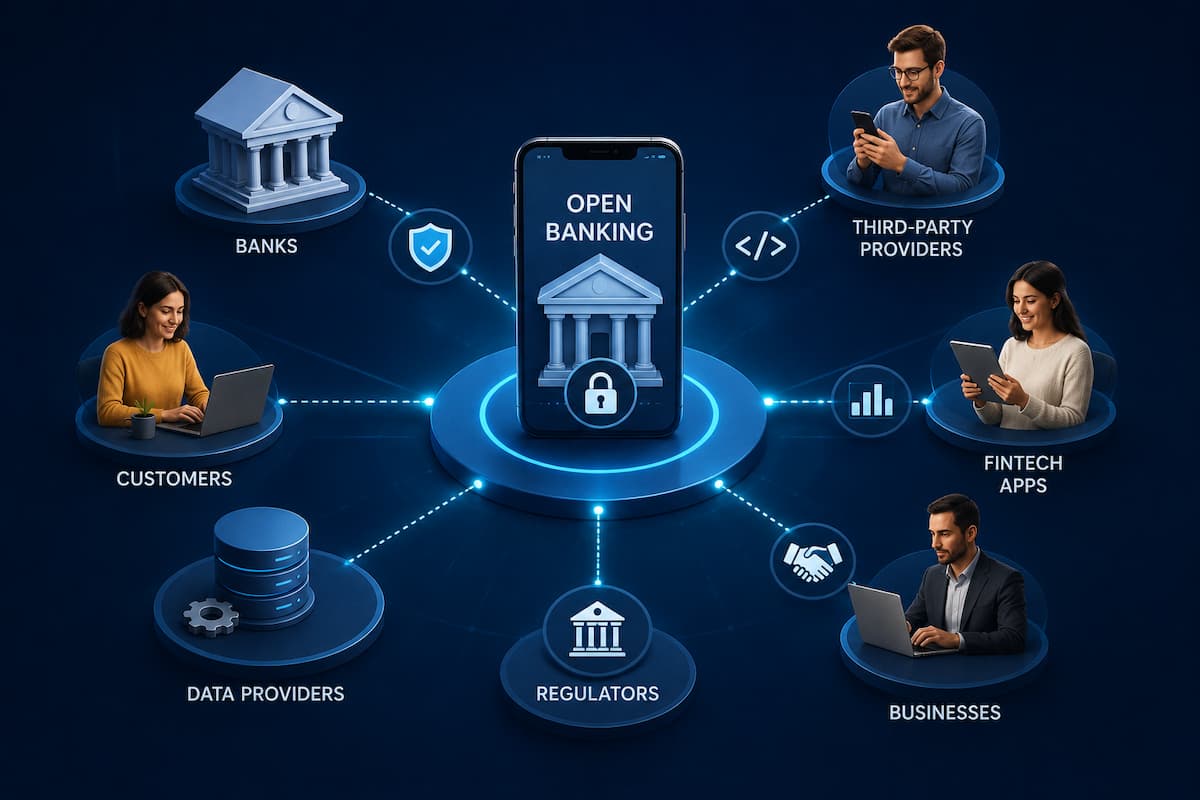
From locked vaults to open highways—how banking quietly transformed into something you control, not something that controls you.
A few years ago, I needed a loan. The process was exhausting. Paperwork, phone calls, waiting, and more paperwork. Then I discovered a lending app that could see my bank transactions — with my permission — and offer me a rate in just minutes. No faxing. No branch visits. Just data moving where I wanted it to go.
That was my first real encounter with open banking. It felt like magic, but it was just technology doing what technology does best: removing friction. This guide is my attempt to unpack that magic into something you can understand, use, and trust.
Why This Matters More Than You Think
Before open banking, your financial data was trapped. Your checking account knew your spending patterns. Your credit card knew your payment history. Your savings account knew your goals. But none of them talked to each other. You were the messenger, manually copying information between silos.
Open banking breaks those silos. It lets your data flow securely between services that you choose. The result is faster decisions, better insights, and tools that actually understand your full financial picture instead of just one slice of it.
The Four Players in Every Open Banking Ecosystem
Open banking is not just banks and apps. It is a carefully structured ecosystem with distinct roles. Understanding who does what helps you trust the system.
| Player | What They Do | What You Should Know |
|---|---|---|
| Account Providers (Banks) | Hold your money, maintain your transaction records, and provide secure access points | They do not share data randomly. They only open the door when you hold the key — your consent. |
| Third-Party Providers (TPPs) | Build apps and services that use your banking data to offer budgeting, lending, investing, or accounting tools | They must be registered and regulated. Check their credentials before connecting. Legitimate TPPs display their registration numbers openly. |
| API Infrastructure | The technical layer that moves data securely between banks and apps using encrypted connections | You never see this, but it is the backbone. APIs use the same security standards as online banking — often stronger. |
| You (The Customer) | Own the data, grant permission, choose which services to use, and revoke access when desired | You are not a passive user. You are the decision-maker. The entire ecosystem revolves around your consent. |
How Consent Actually Works (And Why It Is Not Scary)
Consent is the heart of open banking. Without it, nothing happens. Here is what the process actually looks like when you connect an app to your bank:
1. You Initiate
You open an app — say, a budgeting tool — and click “Connect Your Bank.” The app does not see anything yet. It is just asking for permission.
2. You Authenticate
The app redirects you to your bank’s login page. You enter your credentials directly with your bank — not with the app. The app never sees your password.
3. You Choose
Your bank shows you exactly what data the app wants to access — account balances, transaction history, payment initiation. You select what to share. You can say yes to some and no to others.
4. You Set Limits
Most banks let you set time limits. You might grant access for 90 days. After that, the app must ask again. You are not giving permanent keys.
5. You Stay in Control
You can revoke access anytime — through your bank’s app, through the third-party app, or through a central consent dashboard. The data flow stops immediately.
What I Use Open Banking For (And What I Do Not)
I am selective about which apps I connect. Not because I am paranoid, but because I am practical. Here is my personal breakdown:
• Budgeting apps that aggregate spending across multiple accounts — saves me hours of manual entry
• Accounting software for my side projects — auto-imports transactions, reduces tax-season stress
• Investment platforms that round up purchases and invest the spare change — small automation, big long-term impact
• Lending comparison tools that use my real transaction history to find better rates — replaces guesswork with accuracy
• Apps with unclear privacy policies or no visible regulatory registration
• Services that ask for more data than they need for their stated purpose
• Tools that promise unrealistic returns and want to “manage” my accounts
• Any app where I cannot easily find how to disconnect my bank
Common Myths vs. What Actually Happens
Misinformation about open banking spreads faster than accurate information because fear travels further than facts. Let me address the myths I hear most often:
| Myth | Reality |
|---|---|
| Banks sell your data to anyone who asks | Banks cannot share your data without your explicit, informed consent. Regulatory frameworks like PSD2 in Europe and similar rules elsewhere make unauthorized sharing illegal and heavily penalized. |
| Open banking is less secure than traditional banking | Open banking uses the same encryption standards as online banking — TLS 1.2 or higher, multi-factor authentication, and regular security audits. In many cases, the API infrastructure is newer and more robust than legacy banking systems. |
| Once connected, apps have permanent access | Access is time-limited by default. Most connections expire in 90 days. You can revoke access instantly through your bank or the app. Permanent access is not a feature — it is a bug that regulators actively prevent. |
| Open banking is only for tech-savvy millennials | The fastest-growing user group for open banking services in the UK is actually people over 55, who use it for pension management, simplified budgeting, and easier access to credit. The interface is designed to be simple, not technical. |
| Small fintech companies are less trustworthy than big banks | TPPs must meet strict regulatory standards to access open banking APIs. They are audited, licensed, and monitored. A registered fintech is often more transparent about data use than a traditional bank with opaque policies buried in fine print. |
The Super App Revolution (And Why Your Phone Is Becoming Your Bank)
Open banking enabled something bigger than itself: the super app. These are platforms that combine multiple financial services into one interface. You can check your budget, pay a bill, invest spare change, and compare loan rates all in one place instead of opening five different apps.
This is not just convenience. It is a shift in power. When you spread your financial life across ten institutions, none of them knows you well enough to serve you properly. When it is aggregated in one place—controlled by you—the insights become genuinely useful.
How Open Banking Changed Borrowing (For the Better)
Traditional credit scoring is a black box. A number derived from limited data points determines your financial trustworthiness. Open banking adds transparency to this process.
When you apply for a loan through an open banking-enabled lender, they can see your actual cash flow — income patterns, spending consistency, and savings behavior. This is often a more accurate picture of your financial health than a credit score alone. The result:
- Faster approvals — minutes instead of days
- More accurate rates — based on real behavior, not just historical debt
- Better access for thin-file borrowers — people with limited credit history but stable income
- Lower rejection rates for self-employed and gig workers — whose income looks irregular on paper but is predictable in practice
Security Checklist: What to Verify Before Connecting Any App
I do not connect apps blindly. Here is my personal checklist. Use it, adapt it, make it your own:
- Check registration: Is the app registered as a TPP with the relevant financial authority? In Europe, look for PSD2 registration. In the UK, check the FCA register. In other regions, look for equivalent oversight.
- Read the data policy: What exactly do they collect, how long do they keep it, and do they share it with anyone else? If the policy is vague, that is a red flag.
- Verify the connection method: Does the app redirect you to your bank’s official login page, or does it ask for your credentials directly? Never enter bank credentials into a third-party app. Always authenticate through your bank.
- Check reviews and history: How long has the company existed? What do users say about data handling and disconnection? A new app with no track record is not necessarily bad, but it requires more scrutiny.
- Know your exit: Before connecting, find the disconnect option. If you cannot locate it easily, reconsider. A trustworthy app makes leaving as simple as joining.
- Monitor after connection: Check your bank statements for the first month. Verify that only expected data types are being accessed. If something looks off, revoke immediately.
• The app promises to “optimize” your accounts by moving money automatically without clear rules
• The privacy policy is copy-pasted generic text or hidden behind multiple clicks
• There is no visible customer support channel
• The app pressures you to connect immediately with limited-time offers
• You cannot find the company’s physical address or regulatory registration number
• Reviews mention unauthorized transactions or difficulty disconnecting
Where Open Banking Is Heading
The next phase is already beginning. Open banking is expanding into open finance — a broader concept that includes insurance, investments, pensions, and mortgages. The principle remains the same: your data, your consent, your control. The scope just gets wider.
We are also seeing the rise of variable recurring payments (VRP) — automated payments that adjust based on your account balance. Imagine your utility bill automatically reducing your payment when your balance is low, or increasing your savings contribution when you have a surplus. This is not science fiction. It is being tested in the UK right now.
Artificial intelligence is entering the ecosystem too. Not to replace human judgment, but to enhance it. AI-powered budgeting tools can predict cash flow shortfalls weeks in advance, suggest optimal payment dates to avoid overdrafts, and identify subscription creep before it becomes a problem.
My Personal Getting-Started Roadmap
If you are new to open banking, here is how I would suggest starting:
1. Start With One Account
Do not connect everything at once. Pick one account — ideally a checking account with regular activity — and connect it to one well-reviewed budgeting app. Get comfortable with the consent process before expanding.
2. Review Your Permissions Weekly
For the first month, check your bank’s connected apps section every week. Make sure you understand what is being shared. This builds awareness and confidence.
3. Add a Second Service Only When the First Feels Normal
Once budgeting feels routine, consider adding a savings automation tool or a lending comparison service. Expand slowly. Each addition should feel like a natural next step, not an overwhelming leap.
4. Audit Quarterly
Every three months, review all connected apps. Remove anything you no longer use. Update permissions for anything that is asking for more access than you remember granting. Clean house regularly.
5. Stay Curious, Stay Skeptical
New open banking services are constantly launching. Some are brilliant. Some are questionable. The best protection is a curious mind that asks “how does this work?” and “what am I giving up?” before clicking connect.
Sources and References
- OECD (2026). “Consumer Finance Risk Monitor 2026.” https://www.oecd.org/content/dam/oecd/en/publications/reports/2026/03/consumer-finance-risk-monitor-2026_04395fbd/61f7dbe0-en.pdf
- Financial Education Network (2025). “Malaysia National Strategy for Financial Literacy 2026-2030.” https://www.fenetwork.my/wp-content/uploads/2025/10/FEN_NS2_ENG_Interactive_FA_LowRes.pdf
- European Banking Authority. “Guidelines on the Security Measures for Operational and Security Risks under PSD2.” https://www.eba.europa.eu/regulation-and-policy/psd-2
- Open Banking Implementation Entity (UK). “Open Banking Standard.” https://www.openbanking.org.uk/
- Competition and Markets Authority (UK). “Retail Banking Market Investigation.” https://www.gov.uk/cma-cases/review-of-banking-for-small-and-medium-sized-businesses-smes-in-the-uk
