
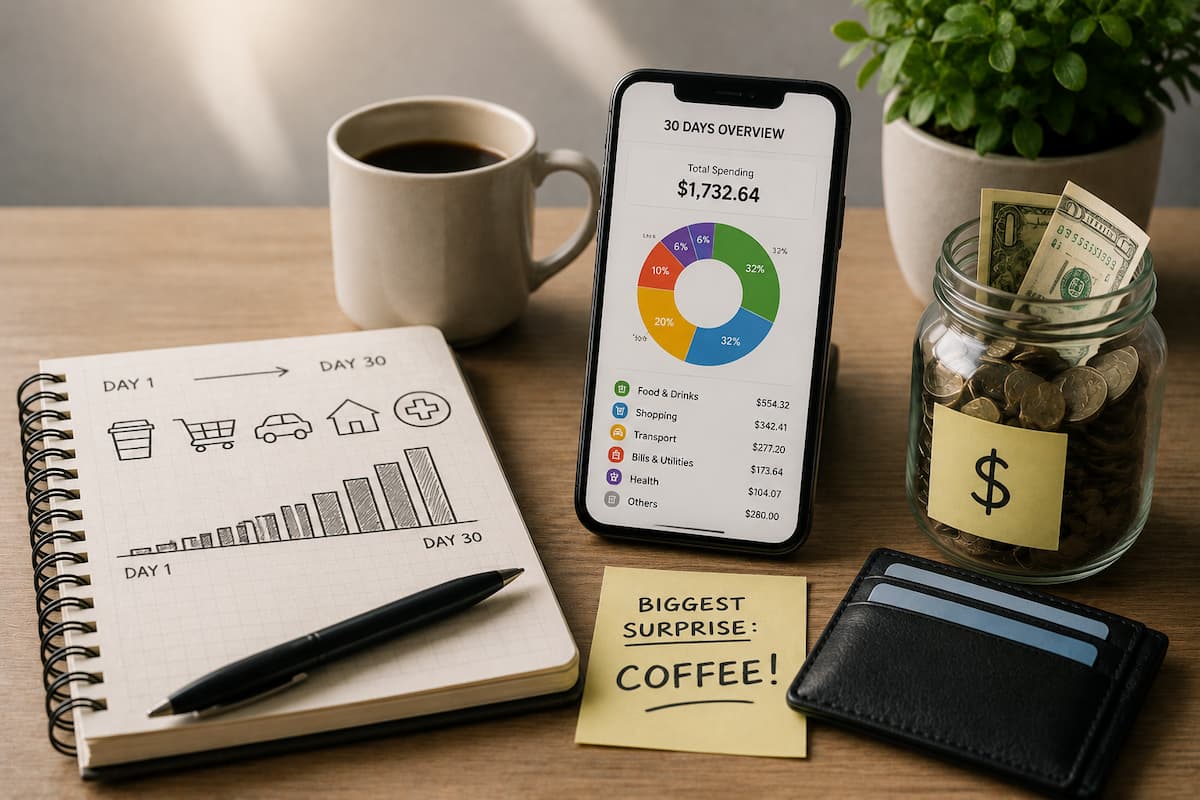
The uncomfortable truth about where my money actually went — and why the numbers I thought I knew were completely wrong. I have always considered myself reasonably good with money. I pay my bills on time. I do not carry credit card debt. I have a savings account with something in it. So when a friend challenged me to track every single dollar for 30 days, I assumed it would be a boring exercise in confirmation. I already knew where my money went, right?
I was wrong. Not slightly wrong. Completely, embarrassingly, change-my-entire-behavior wrong. Thirty days of tracking revealed patterns I had been blind to for years. Some were harmless. Others were quietly destroying my financial progress. Here is exactly what happened, day by day, discovery by discovery.
Week One: The Shock of Visibility
The first week was the hardest. Not because tracking was difficult — it was surprisingly easy — but because seeing the numbers accumulate in real time changed my behavior immediately. I found myself hesitating before small purchases, not because I had a budget, but because I did not want to type another entry into my phone.
By day seven, I had recorded 47 transactions. Forty-seven. In one week. I had estimated my weekly spending at around $400. The actual number was $683. The gap was not from one big purchase. It was from death by a thousand tiny cuts.
Week Two: The Subscription Trap
Week two is when I started digging into automatic deductions. I knew I had subscriptions. I did not know I had this many subscriptions. When I listed them all, the number was staggering.
| Service | Monthly Cost | Last Used | Annual Waste |
|---|---|---|---|
| Streaming Service A | $14.99 | 3 weeks ago | $179.88 |
| Streaming Service B | $9.99 | Yesterday | $0 (keeping) |
| Music App | $10.99 | Daily | $0 (keeping) |
| Cloud Storage | $5.99 | 6 months ago | $71.88 |
| News Subscription | $12.00 | 2 weeks ago | $144.00 |
| Fitness App | $19.99 | Never (free trial converted) | $239.88 |
| Meal Kit Service | $49.99 | 1 month ago | $599.88 |
| Total | $123.94 | $1,235.52 |
Over $1,200 per year on services I barely used. The meal kit was the most painful. I signed up for a free trial, forgot to cancel, and paid $50 monthly for three months of nothing. The fitness app was worse — I never even opened it after installation. The free trial ended, and my card kept getting charged.
Week Three: The Social Spending Blind Spot
Week three revealed my most expensive hidden category: social spending. Not going out to dinner. Not concert tickets. The small, social moments that felt free but were not.
Here is what one typical week looked like:
- Monday: “Quick coffee” with a colleague. $8.50 for my drink. $0 for the conversation. Total: $8.50.
- Wednesday: Splitting a lunch bill where I ordered a $12 salad but the group ordered appetizers I did not want. My share: $19.00.
- Friday: Drinks with friends. Two rounds bought for the group. My consumption: $18. My contribution: $47.
- Saturday: Birthday gift for a friend I barely know, purchased last-minute at a premium store. $35.
- Sunday: Brunch that ran three hours and involved three mimosas I did not finish. $42.
Total social spending for that week: $151.50. Multiply by four weeks: $606 per month. Multiply by twelve: $7,272 per year. On social moments. Not rent. Not food. Not transportation. Just being around other people.
Week Four: The Grocery Store Lie
I always told myself I was “good at groceries.” I meal planned. I bought generic brands. I avoided waste. Week four proved I was lying to myself.
My weekly grocery bill averaged $127. Not terrible for one person. But when I categorized what I actually bought, the picture changed:
| Category | Weekly Spend | Percentage | Actual Need Level |
|---|---|---|---|
| Fresh produce and proteins | $48 | 38% | High — actual food |
| Snacks and convenience items | $31 | 24% | Low — emotional eating |
| Beverages (non-essential) | $22 | 17% | Low — soda, fancy water, juice |
| “Just in case” items | $18 | 14% | None — duplicates of what I already had |
| Impulse checkout items | $8 | 6% | None — magazines, gum, candy |
Only 38% of my grocery spending was on actual meals. The rest was comfort, convenience, and poor planning. I was not grocery shopping. I was emotionally shopping at a grocery store.
The Numbers That Changed Everything
At the end of 30 days, I totaled everything. The results were not pretty, but they were honest. Here is the complete breakdown:
| Category | 30-Day Total | Monthly Estimate (Pre-Tracking) | Gap |
|---|---|---|---|
| Housing and Utilities | $1,245 | $1,200 | +$45 |
| Food (groceries + dining) | $847 | $600 | +$247 |
| Transportation | $312 | $250 | +$62 |
| Subscriptions | $124 | $60 | +$64 |
| Social Spending | $651 | $200 | +$451 |
| Miscellaneous / Unidentified | $438 | $150 | +$288 |
| Total | $3,617 | $2,460 | +$1,157 |
I was spending $1,157 more per month than I thought I was. That is $13,884 per year. Almost $14,000 of invisible money, disappearing into habits I did not even know I had.
What I Changed (And What Stuck)
Tracking alone does not fix anything. It just shows you the problem. The real work is changing behavior. Here is what I implemented after the 30 days, and what actually worked:
What Worked
- Cash for social spending: $40 per outing, no exceptions. This single change reduced my social spending by 65% without reducing my social life. I just became more intentional.
- Subscription audit: Canceled four services, saved $74 monthly. Re-subscribed to one three months later when I actually needed it. Net savings: $59 monthly.
- Grocery list discipline: No list, no store. If it is not on the list, it does not go in the cart. My grocery spending dropped from $127 weekly to $89 weekly. The $38 difference is mostly snacks and beverages I do not miss.
- 24-hour rule: Any non-essential purchase over $20 requires a 24-hour wait. I still buy most of what I want. But about 30% of items never get purchased because the desire fades. That 30% was pure impulse.
What Did Not Work
- Comprehensive budgeting apps: I tried three. They were too complicated, too judgmental, and too time-consuming. I abandoned all of them within a week. The simple notes app was more effective because it had no opinions — just data.
- Cutting coffee completely: I tried switching to home-brewed only. I lasted four days. The deprivation made me miserable, and on day five I bought a $7 latte out of rebellion. Now I allow myself two coffee shop visits per week, planned in advance. Sustainable beats perfect.
- Automatic savings transfers: I set up aggressive auto-transfers. They overdrafted my account twice because I had not adjusted my spending yet. I reduced the amount and increased it gradually. Slow automation works. Fast automation backfires.
What I Would Do Differently Next Time
If I were to repeat this experiment, I would make three adjustments:
- Track emotions, not just dollars: Every purchase has a feeling attached to it. Boredom, stress, celebration, loneliness. I did not record these during the 30 days, but they explained more than the categories did. Next time, I will add a one-word emotion tag to each entry.
- Start on a normal month: I tracked during a month with two birthdays and a holiday. My social spending was artificially high. A more typical month would have given me a better baseline.
- Involve my partner: I tracked alone. If I had done this with my partner, we would have caught shared spending blind spots — duplicate subscriptions, overlapping grocery purchases, uncoordinated social commitments.
Thirty days of tracking every dollar was uncomfortable, tedious, and occasionally embarrassing. It was also the most valuable financial exercise I have ever done. Not because it made me rich. Because it made me honest. And honesty, it turns out, is the only real starting point for financial change.
